How to Write Tourism Announcements That Get Read
By • July 31, 2026

Tourism announcements are professional updates used by travel brands to communicate news, such as new lodge openings, route expansions, or event launches. Effective announcements prioritize clarity over hype, using a direct structure that informs guests, media, and search engines exactly what has changed and why it matters to the reader.
What is the most overused phrase in tourism announcements?
If you have spent any time reading travel industry news, you have likely encountered the phrase "We are thrilled to announce" or "We are proud to present." While these sentiments are genuine, they have become the most overused clichés in tourism communication. When every update starts with the business’s internal emotions, the reader’s needs are pushed to the background. In a fast-paced digital world, guests and travel agents are looking for the "what" and the "how" before they care about the "thrill."
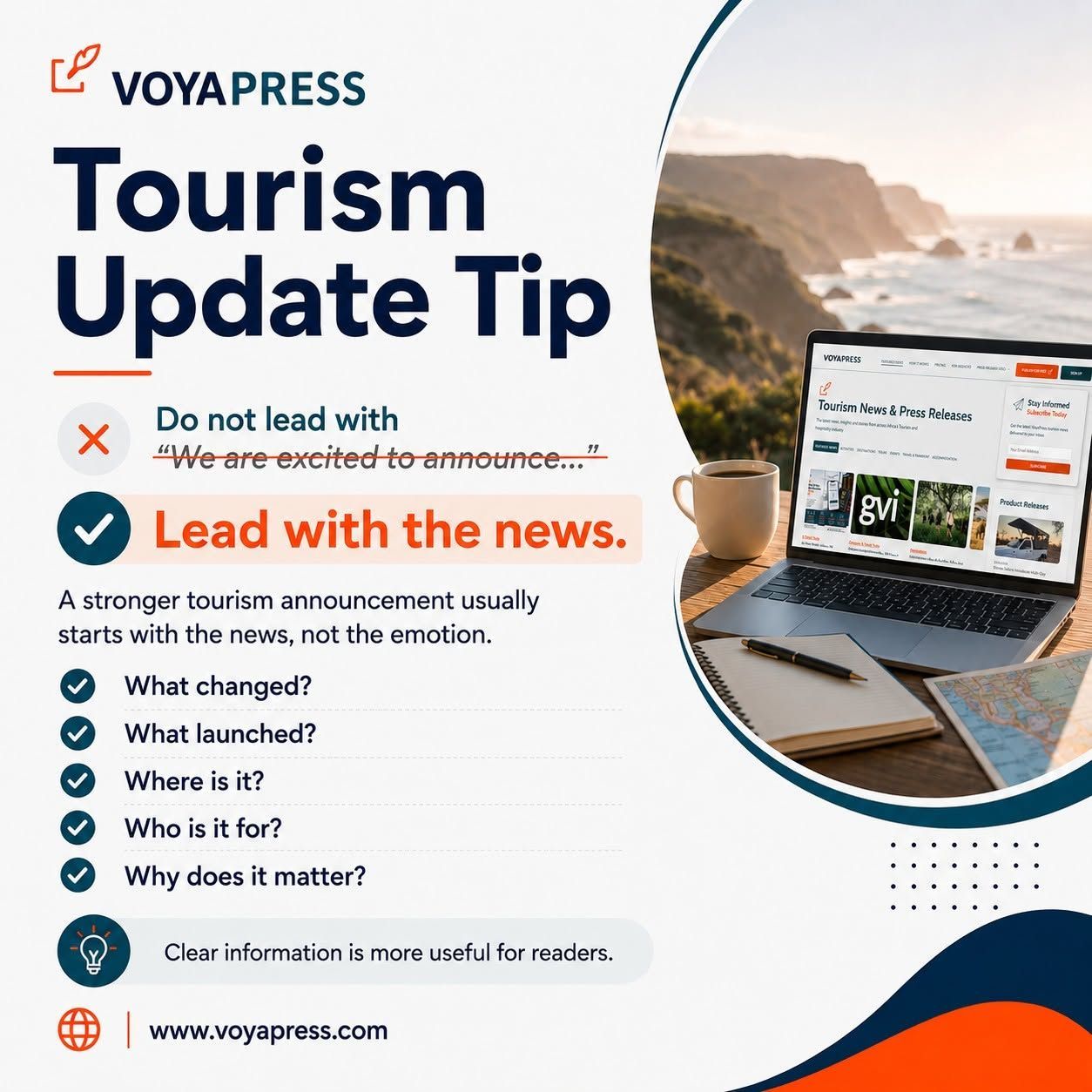
Using tired phrases makes your news sound like every other corporate update. To stand out, you must break away from the template. Instead of focusing on your excitement, focus on the utility of the news. For example, if you are launching a new safari route, start with the benefit to the traveler.
Consider these alternatives to common clichés:
- "Travelers can now access..."
- "A new partnership between X and Y simplifies..."
- "Effective immediately, the [Destination] experience includes..."
- "[Business Name] has redesigned its guest experience to..."
- "New data shows that [Trend] is changing how guests..."
By removing the fluff, you respect the reader's time. This is especially important for the African tourism industry where unique stories often get buried under standard corporate jargon. When you write for clarity, you ensure that your message reaches the people who actually need the information.
Why does your opening sentence determine your success?
The first sentence of your tourism announcements acts as a gatekeeper. If it is interesting and informative, the reader continues. If it is vague or self-indulgent, they click away. Digital attention spans are shorter than ever, and AI-driven search engines now scan the first few lines of a post to determine its relevance for featured snippets.
An effective opening should answer the core questions of journalism: Who, What, Where, When, and Why. If a journalist from a major travel publication picks up your release, they should be able to write a headline based solely on your first paragraph. If they have to dig through three paragraphs of company history to find the news, they will likely move on to a competitor’s update.
Furthermore, your opening sets the tone for the entire piece. A conversational but professional tone builds trust. It suggests that your business is transparent and confident. When you lead with facts, you position your brand as a reliable source of information within the industry news sector. This reliability is what turns a one-time reader into a long-term partner or guest.
The Inverted Pyramid Writing Technique
To ensure your tourism announcements are effective, you should adopt the "Inverted Pyramid" style of writing. This is a classic journalistic framework where the most critical information is placed at the very top, followed by supporting details, and ending with background information. This structure is perfect for the modern web because it caters to both "skimmers" and deep readers.
In the Inverted Pyramid model, the lead paragraph is the widest part of the pyramid. It carries the weight of the news. As the reader moves down, the information becomes more niche. For instance, if you are announcing a new eco-lodge, the top of the pyramid is the opening date and location. The middle section discusses the sustainable features and room types. The bottom section includes the founder’s quote and the company’s mission statement.
This technique offers several benefits:
- Immediate Value : Readers get the news instantly.
- SEO Friendliness : Keywords appear early, helping search engines index the topic.
- Ease of Editing : If space is limited, the bottom of the text can be cut without losing the core message.
- AI Extraction : AI tools can easily summarize your post for voice search or chat answers.
- Professionalism : It mirrors the format used by major news agencies.
When applying this to new products in the travel space, remember that your goal is to inform first and sell second. A well-informed reader is much more likely to become a high-value customer than one who feels they are being fed a sales pitch.
How can you optimize tourism announcements for AI search?
Answer Engine Optimization (AEO) is the new frontier of digital marketing. Tools like ChatGPT, Gemini, and Google’s Search Generative Experience (SGE) look for direct answers to user queries. If someone asks, "What are the latest travel updates in East Africa?", you want your announcement to be the source the AI quotes. To achieve this, your tourism announcements must be structured for extractability.
One of the best ways to do this is by using question-based headings. When your H2 or H3 tags match the exact questions people type into search bars, you increase your chances of appearing in a "Featured Snippet." For example, instead of a heading like "Our Logistics," use "What are the transport options for the new route?" This alignment between your content and user intent is the key to modern SEO.
Additionally, use structured formatting such as bullet points and numbered lists. AI algorithms prefer lists because they are easy to parse and present as a concise answer. If you are detailing the steps of how it works for a new booking system, a numbered list is far superior to a dense paragraph. This doesn't just help the machines; it makes your content significantly more readable for humans on mobile devices who are quickly scrolling through their feeds during a commute.
Mastering the Art of Direct Communication
Direct communication in tourism announcements means saying more with fewer words. In the African tourism market, where cross-border travel and complex logistics are common, clarity is a competitive advantage. Guests are often anxious about the details—visa requirements, health protocols, or transfer times. If your update addresses these concerns directly, you reduce the friction of the booking process.
Avoid using industry jargon that might confuse a first-time traveler. While "RevPAR" or "mICE" might mean something to hotel managers, they mean nothing to a guest looking for a holiday. Instead, use language that evokes the experience while remaining grounded in fact. Describe the "unobstructed views of the savannah" rather than just saying the property has "high-quality scenic positioning."
Directness also applies to your Call to Action (CTA). Every announcement should tell the reader exactly what to do next. Do they need to submit a press release of their own? Should they check the activities page? Should they book via a specific link? A vague "contact us for more" is rarely as effective as a specific instruction like "Download the full 2026 itinerary here."
What are the key elements of an effective travel update?
Every time you sit down to write, ensure your tourism announcements contain these essential components to maximize their reach and impact:
- A Punchy Headline : Keep it under 60 characters and include your main keyword.
- Dateline : Clearly state the city and date so media outlets know the news is current.
- The Lead : The 5Ws (Who, What, Where, When, Why) in the first 40 words.
- Multimedia Links : Links to high-resolution images or video b-roll for the press.
- Boilerplate : A short "About Us" section at the end that provides context on your brand.
Including these elements ensures that your update meets the standard editorial guidelines expected by professional journalists. It transforms a simple blog post into a functional piece of media collateral that can be picked up by news desks across the continent. When your content is easy to use, you become a favorite source for travel writers who are often working on tight deadlines and looking for ready-to-publish material.
Distribution Strategies for African Tourism
Writing a great announcement is only half the battle; the other half is getting it in front of the right eyes. In Africa, the tourism landscape is vast and fragmented. You need a distribution strategy that covers local, regional, and international audiences. This involves a mix of social media, email newsletters, and dedicated press release platforms.
Using a platform like VoyaPress allows you to target specific segments, such as accommodation or events . By categorizing your news correctly, you ensure it reaches the agents and operators who specialize in that niche. Furthermore, internal linking within your announcements—pointing back to your blog or industry news sections—helps build a web of authority around your brand. This practice improves your site's overall SEO, making it easier for future announcements to rank well on Google.
Core Takeaways for Writing Better Tourism Announcements
Writing for the tourism industry in 2026 requires a balance of human storytelling and technical optimization. To ensure your updates don't get lost in the noise, remember to prioritize the reader's needs from the very first syllable. Clear communication isn't just about being understood; it's about being useful to your audience and the AI tools they use to find information.
- Lead with the News : Place the most important facts in the first sentence to capture attention immediately.
- Ditch the Clichés : Replace "thrilled to announce" with direct, benefit-driven language.
- Structure for AI : Use question-based H2 headings and bulleted lists to win featured snippets.
- Be Specific : Address the Who, What, Where, When, and Why in the opening paragraph.
- Direct Call to Action : Provide clear next steps for the reader to follow, such as visiting the destinations page.
Publish your next tourism announcement on VoyaPress and create a relevant external article that links back to your most important page.

Stay Informed
Get the latest VoyaPress tourism news delivered to your inbox
VoyaPress Newsletter Signup
Thank You For Signing Up.
Keep and Eye on Your Inbox
Please try again later.
Latest Posts